
A Marker for the Fort Gower Resolves
Source: Local Historian Column (2019)
Format: Newspaper column (archival PDF)
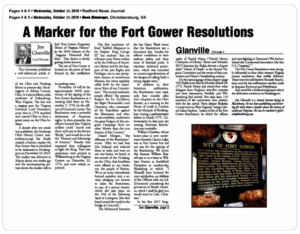
📥 A Marker for the Fort Gower Resolutions (2019) — archival PDF
📎 Opens in a new tab — use “Save As” to download.
📜 Part of the Holstonia.co Knowledge Base. Redistribution not permitted.
Overview
This entry preserves Dr. James O. Glanville’s 2019 Local Historian column documenting the dedication of the Fort Gower Resolves historical marker in Hockingport, Ohio, while examining the enduring historical significance of the Fort Gower Resolves of November 5, 1774.
The column explores how a declaration adopted by the officers of Lord Dunmore’s army on Virginia’s western frontier became one of the earliest public expressions of American rights preceding the Revolutionary War. By placing the marker within its broader historical context, Dr. Glanville demonstrates why the Fort Gower Resolves deserve greater recognition in both Virginia and American history.
Historical Context: Fort Gower and Revolutionary Virginia
In the closing days of Lord Dunmore’s War, Virginia officers assembled at Fort Gower near the confluence of the Ohio and Hocking Rivers. There they responded to the recent actions of the First Continental Congress by adopting the Fort Gower Resolves, affirming both their loyalty to the Crown and their willingness to defend American liberties if called upon by their country.
Published in the Virginia Gazette in December 1774, the Resolves quickly circulated throughout the colonies and even reached Great Britain, where portions were later quoted during debate in the House of Lords. Their influence extended well beyond the frontier and helped shape early Revolutionary thought.
Marker Dedication & Public Memory
Dedicated in November 2019, the Fort Gower historical marker commemorates the location where the Resolves were adopted and serves as a lasting reminder of an event often overlooked in traditional narratives of the American Revolution.
Dr. Glanville’s column explains both the historical importance of the Resolves and the decades-long effort to secure broader public recognition for their role in early American constitutional history.
Regional and National Significance
Although adopted on Virginia’s western frontier, the Fort Gower Resolves carried implications far beyond the Ohio Valley. The document demonstrated that frontier Virginians were actively engaged in the political debates unfolding across the colonies and helped illustrate the military confidence, political resolve, and emerging identity that would characterize the Revolutionary movement.
The dedication of the historical marker represents an important step toward restoring this chapter of Virginia history to its proper place within the broader American story.
Source Context & Archival Note
This entry is based on a Local Historian column published on October 23, 2019, in the Radford News Journal and News Messenger (Christiansburg, Virginia).
The column reflects Dr. Glanville’s continuing commitment to documenting overlooked episodes in Virginia history and preserving historically grounded scholarship for both public and academic audiences.
Archival Preservation
The original column is preserved within the Holstonia Knowledge Base to ensure:
• Long-term digital durability
• Public accessibility
• Regional historical continuity
• Proper attribution of authorship
Every archive builds upon another. Explore additional research, historical publications, and preserved works documenting the people, places, archaeology, and history of the Appalachian region.
↳ Explore the Knowledge Base