
The Civil War Skirmish at Pearisburg
Source: Local Historian Column (2019)
Format: Newspaper column (archival PDF)
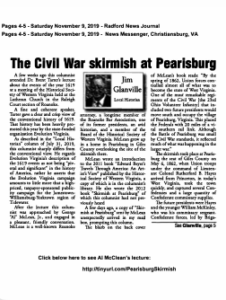
📥 The Civil War Skirmish at Pearisburg (1862) — archival PDF
📎 Opens in a new tab — use “Save As” to download.
📜 Part of the Holstonia.co Knowledge Base. Redistribution not permitted.
Overview
This entry preserves a 2019 Local Historian column by Dr. James O. Glanville examining the Civil War skirmish at Pearisburg, Virginia, and its broader relevance within the military and logistical landscape of Southwest Virginia.
The column situates the May 6, 1862 engagement within regional Civil War dynamics, connecting a small-scale conflict to broader patterns of rail infrastructure, troop movement, and territorial control.
Historical Context: Southwest Virginia in the Civil War
During the Civil War, Southwest Virginia held strategic importance due to the Virginia and Tennessee Railroad, which connected Bristol to Lynchburg and served as a critical logistical corridor for the Confederacy.
Control of this rail line influenced troop movement, supply distribution, and regional military operations, making even smaller engagements in the region operationally significant.
The Skirmish at Pearisburg (May 6, 1862)
The skirmish occurred when Union forces under Lieutenant Colonel Rutherford B. Hayes advanced from Princeton (in present-day West Virginia) and occupied Pearisburg, capturing Confederate personnel and supplies.
Confederate forces, led by Brigadier General Henry Heth, responded by pushing Union troops out of the town and back toward Narrows over several days.
Despite the presence of notable figures — including future U.S. Presidents Hayes and William McKinley — the engagement remained limited in scale, with minimal casualties and characteristics consistent with a rear-guard action.
Regional Significance
While small in scale, the Pearisburg skirmish reflects broader Civil War patterns in Southwest Virginia, where control of transportation infrastructure and geographic positioning played a decisive role.
Subsequent engagements, including the Battle of Cloyd’s Mountain (1864), further illustrate the region’s strategic importance and the intensity of conflict tied to the railroad corridor.
Source Context & Archival Note
This entry is based on a Local Historian column published in November 2019 in the Radford News Journal and News Messenger (Christiansburg, VA).
The column reflects Dr. Glanville’s continued work in documenting and interpreting the historical landscape of Southwest Virginia through locally grounded research and accessible public scholarship.
Archival Preservation
The original column is preserved within the Holstonia Knowledge Base to ensure:
• Long-term digital durability
• Public accessibility
• Regional historical continuity
• Proper attribution of authorship
Every archive builds upon another. Explore additional research, historical publications, and preserved works documenting the people, places, archaeology, and history of the Appalachian region.
↳ Explore the Knowledge Base